
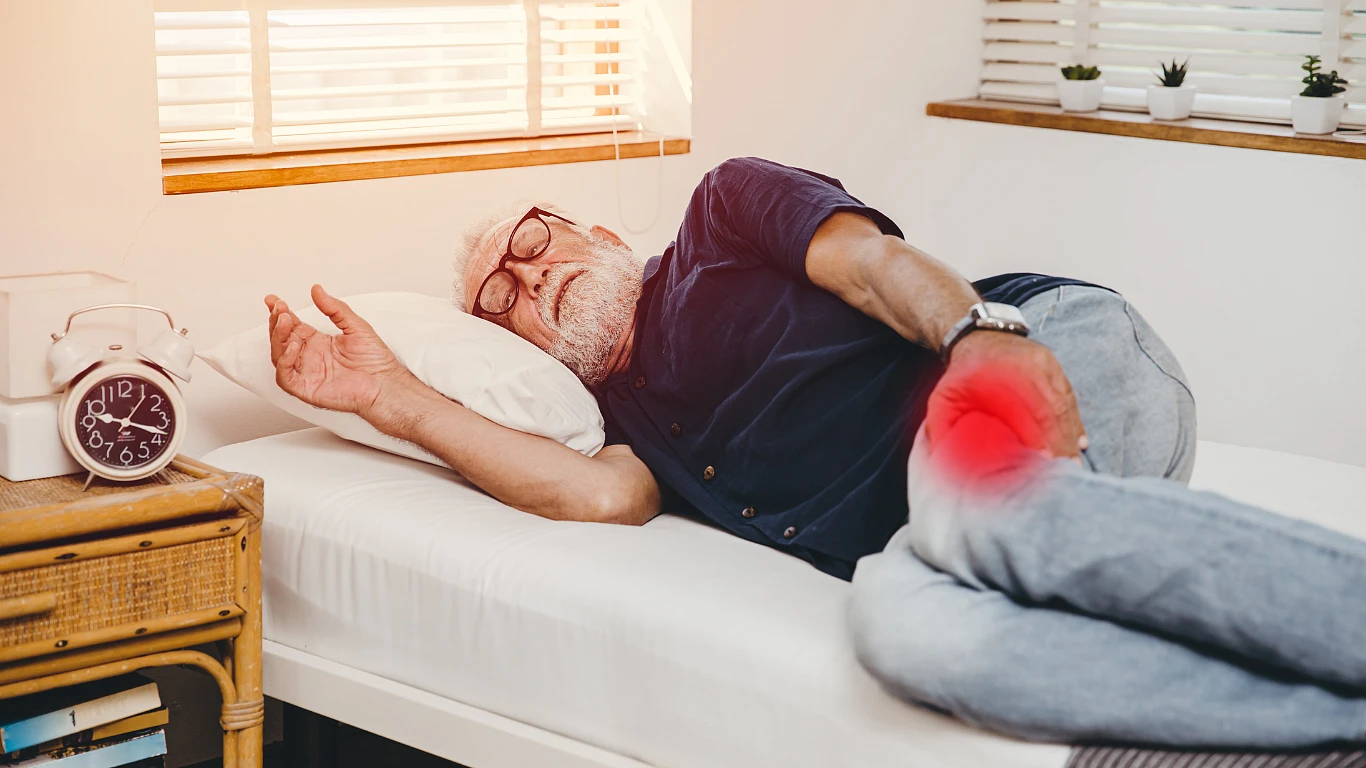
Your legs shake after a few steps, and getting out of a chair now requires both hands.
Walking more seems like the obvious answer. Yet you can walk every day without giving weakened thigh muscles enough resistance to rebuild the strength needed for stairs, balance, and standing.
There is a simple bed exercise that targets those muscles directly. It is called a quadriceps set, and it can be a useful starting point when ordinary walking feels exhausting or unsafe.
First, the “100X Faster” Claim Needs Context

There is no accepted scientific measurement showing that one quadriceps set strengthens the legs exactly 100 times faster than walking.
The evidence supports a more believable conclusion. Targeted resistance exercise usually produces a stronger muscle building stimulus than casual walking, while walking remains valuable for endurance, circulation, cardiovascular health, and mobility.
A systematic review of walking programs in older adults found that walking alone may improve walking endurance and health related quality of life.
However, the certainty of evidence across outcomes was rated very low, and the researchers said more work was needed to understand its effects on physical function.
By comparison, a large review of progressive resistance training found that older adults can make meaningful improvements in muscular strength and physical function when muscles are progressively challenged.
That does not mean you should stop walking. It means walking and strengthening solve different parts of the problem.
| Activity | Main training effect | Quadriceps challenge | Balance required | Best role |
|---|---|---|---|---|
| Comfortable walking | Endurance and repeated movement | Usually low to moderate | Moderate | Heart health, stamina, mobility |
| Brisk or uphill walking | Endurance with greater leg demand | Moderate | Moderate to high | Fitness for capable walkers |
| Quadriceps set | Direct isometric thigh contraction | Adjustable | None while lying down | Early strength activation |
| Sit to stand | Functional leg strength and power | Moderate to high | Moderate | Chair rising and daily function |
| Loaded resistance exercise | Progressive strength and muscle growth | High when prescribed well | Varies | Longer term strength development |
Current physical activity guidance reflects this distinction. Adults aged 65 and older are advised to combine aerobic movement with muscle strengthening and balance activities rather than relying on walking alone.
The Bed Exercise That Directly Targets Weak Thighs
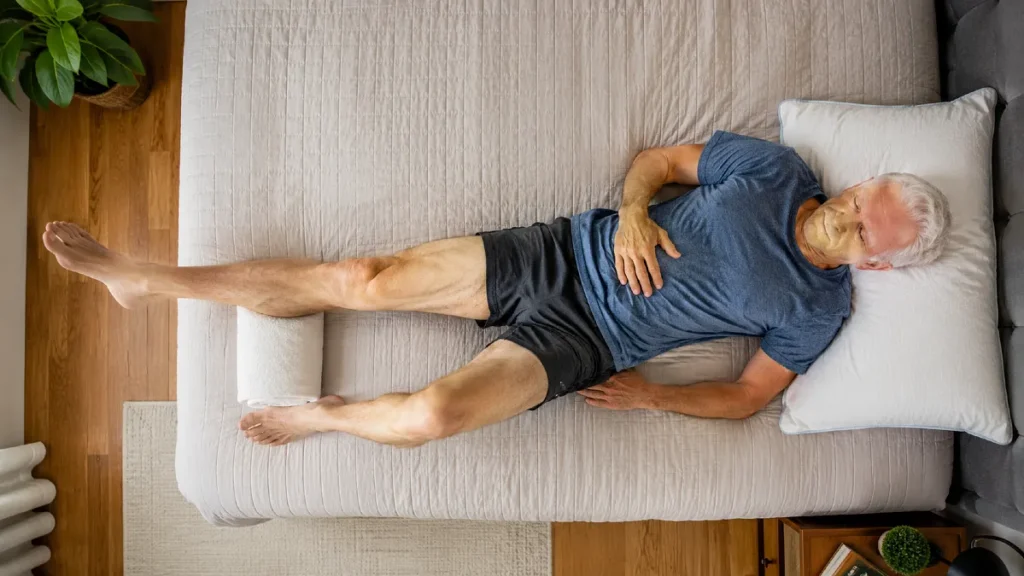
A quadriceps set is an isometric contraction.
Isometric means the muscle produces tension without creating much visible joint movement. Your knee remains straight while the quadriceps on the front of your thigh tighten.
The quadriceps help straighten the knee. They contribute whenever you rise from a chair, steady yourself on a step, control the knee while walking, or keep the leg from buckling.
A quad set does not require you to stand, balance, lift a weight, or bend an irritated knee. That makes it useful during early rehabilitation or when leg weakness makes upright exercise difficult.
The American Academy of Orthopaedic Surgeons includes quadriceps sets in rehabilitation guidance after knee and hip surgery. Its instructions involve tightening the thigh, attempting to straighten the knee, holding the contraction for 5 to 10 seconds, and repeating the exercise.
How to Perform a Quadriceps Set in Bed
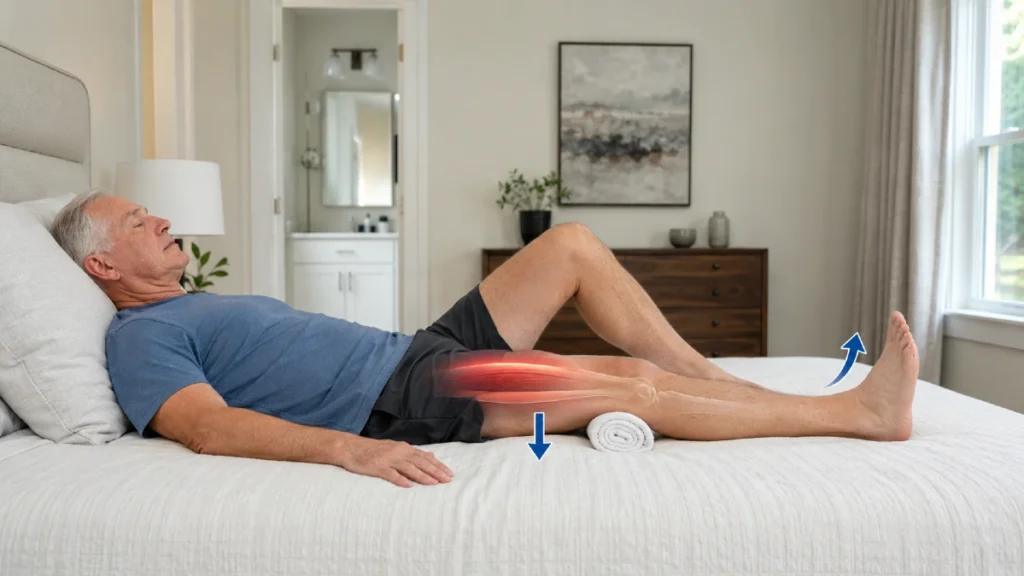
Lie on your back with both legs extended comfortably.
Your head and neck should feel supported. If lying completely flat bothers your back, elevate your upper body slightly or ask a physical therapist to help you find a better position.
Place a small rolled towel beneath the knee you are exercising. The towel is optional, but it can give you something to press against and make the contraction easier to feel.
Pull your toes gently toward your face.
Now press the back of your knee downward into the mattress or towel. Imagine that you are trying to flatten the towel using only your thigh.
You should feel the muscle above your kneecap become firm. Your kneecap may appear to move slightly toward your hip.
Hold the contraction for 5 seconds while breathing normally.
Release completely for 5 to 10 seconds. Then repeat.
Complete the repetitions on one leg before switching sides, unless your physical therapist has given you different instructions.
| Training detail | Beginner starting point | Possible progression |
| Contraction time | 5 seconds | 8 to 10 seconds |
| Rest between contractions | 5 to 10 seconds | At least 5 seconds |
| Repetitions | 5 per leg | 10 per leg |
| Sets | 1 set | 2 sets |
| Sessions | Once daily | Once or twice daily |
| Effort | Firm but comfortable | Strong contraction without pain |
Official hospital exercise guidance commonly uses holds of approximately 5 to 10 seconds and about 10 repetitions for static quadriceps work.
Exercise amounts should be individualized. A person recovering from surgery, stroke, a blood clot, a fracture, or prolonged bed rest may need a different plan, so follow the instructions provided by the treating clinician.
Why This Can Feel More Effective Than Walking
It Makes the Target Muscle Work Deliberately
During comfortable walking, the body tries to move efficiently.
Momentum, the opposite leg, the hips, and the ankle muscles all contribute. A person with weak quadriceps may unconsciously shorten each step or shift weight away from the weaker side.
A quad set removes much of that compensation. The purpose of the movement is simply to produce tension in the quadriceps.
That targeted tension is what walking may fail to provide when someone moves slowly, takes very short steps, or stops frequently because of fatigue.
It Can Be Practiced Before Standing Feels Safe
Someone who struggles to rise from a chair may not yet be ready for repeated squats or unsupported chair stands.
A bed exercise allows the person to begin activating the thigh without the fear of falling. The exercise can also help someone relearn what a strong quadriceps contraction feels like.
That accessibility is valuable, but it should not be mistaken for unlimited effectiveness. As the exercise becomes easy, it must eventually be progressed if the goal is continued strength development.
It Supports a Gradual Return to Functional Training
Strength gains are specific to the movement and the challenge being practiced.
Pressing the knee into a mattress can improve the ability to activate the quadriceps. Standing from a chair later teaches that muscle to work with the hips, ankles, trunk, and balance system.
Research comparing walking with walking plus home resistance exercise found that both approaches improved some measures in older adults, but adding resistance exercise produced a greater improvement in quadriceps muscle quality. The trial included 64 participants and lasted 10 weeks.
The practical lesson is not that bed exercise defeats walking. It is that walking often works better when it is paired with strengthening.
A Four Week Progression From Bed to Better Mobility

Do not rush from severe weakness into difficult standing exercise.
Use the quadriceps set as the first rung of a ladder. Progress only when the current level feels controlled and does not increase pain, swelling, dizziness, or instability.
| Stage | Main exercise | Suggested goal | Sign you may be ready to progress |
| Week 1 | Quadriceps sets | 5 contractions per leg, once daily | You can hold each contraction for 5 seconds |
| Week 2 | Quadriceps sets | 8 to 10 contractions per leg | The thigh tightens firmly without shaking |
| Week 3 | Quad sets plus straight leg raises if approved | 5 controlled leg raises per side | The knee stays straight during the lift |
| Week 4 | Quad sets plus supported sit to stand | 3 to 5 chair rises | You stand with control and no knee buckling |
This is an example rather than a treatment prescription. Some people will progress faster, while others may need several weeks at the first stage.
A straight leg raise adds movement and requires the quadriceps to keep the knee extended while the leg lifts. AAOS guidance recommends tightening the thigh, keeping the knee straight, slowly lifting the leg about a foot, holding for 3 to 5 seconds, and lowering with control.
Repeated sit to stand exercise has also been studied in physically frail older adults and has been shown to improve muscle strength and reduce the muscular demands of the task.
The Common Mistakes That Reduce the Benefit

Pressing With the Heel Instead of the Thigh
Your heel may push into the mattress while the quadriceps remain soft.
Place two fingers on the front of your thigh. You should feel the muscle tighten immediately when the back of the knee presses down.
Holding Your Breath
Breath holding can cause unnecessary straining.
Count aloud during each hold. Speaking makes it difficult to hold your breath and helps you keep the timing consistent.
Contracting as Hard as Possible on the First Day
A stronger contraction is not always a safer contraction.
Begin with a firm effort that does not cause sharp pain, cramping, trembling, or pressure in the chest or head. Increase effort gradually as control improves.
Using a Mattress That Is Too Soft
A very soft mattress may absorb the force and make the knee difficult to press downward.
Place a folded towel beneath the knee, try a firmer section of the bed, or perform the exercise on a padded firm surface if getting down and back up is safe.
Expecting One Exercise to Fix Every Cause of Weak Legs
Weak legs can result from inactivity, arthritis, pain, medication effects, poor nutrition, anemia, nerve compression, neuropathy, cardiovascular disease, stroke, muscle disease, or other medical conditions.
An exercise can strengthen a deconditioned muscle. It cannot diagnose the reason that muscle became weak.
Try This Today
Try this today
The Daily Leg Activation Habit
Begin the day with controlled quadriceps tension rather than force. Five good contractions on each leg are enough to practice the pattern.
Controlled repetition rhythm
Perform five quadriceps sets on each leg after waking. Let each repetition finish completely before beginning the next.
Stay firm for 5 seconds
Keep the thigh engaged without straining or turning the contraction into a painful effort.
Do not hold your breath
Keep breathing calmly through the five-second contraction and rest fully before repeating.
Consistency matters more than forcing a painful contraction.
The goal is to create repeated, good quality muscle tension and then progress toward more functional exercise when you are ready.
What Quad Sets Cannot Replace
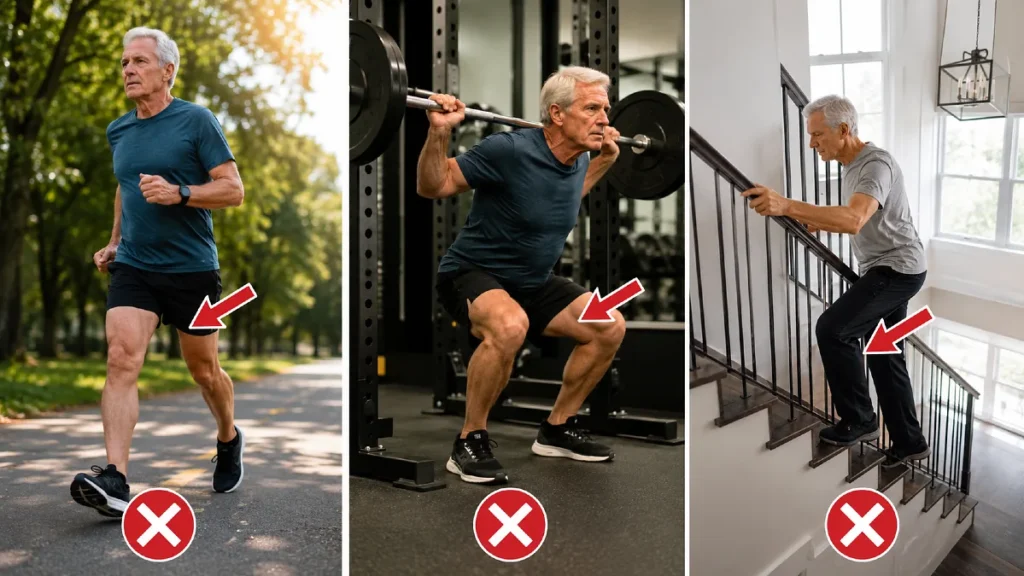
Quad sets do not provide the cardiovascular challenge of brisk walking.
They do not train dynamic balance, foot placement, reaction speed, or the coordination required to avoid obstacles. They also provide limited strengthening for the calves, hamstrings, hips, and trunk.
Exercise programs that combine balance, functional movement, and resistance appear more useful for fall prevention than relying on a single category.
A Cochrane review covering 108 randomized trials and 23,407 older adults found that exercise programs reduced the rate of falls by about 23 percent.
Programs combining several exercise types, commonly balance, functional, and resistance work, may reduce fall rates more than a single type alone.
Keep walking if your clinician considers it safe. Add strength and balance work rather than treating the quad set as a permanent replacement for movement.
How Long Before Your Legs Feel Stronger?
Some people feel better muscle control within the first several sessions.
Visible or functional changes usually require repeated training over weeks, not one night. AAOS conditioning programs commonly suggest continuing exercises for roughly 4 to 6 weeks before moving into maintenance, although recovery plans vary by diagnosis.
Early changes may include feeling the thigh tighten more clearly, keeping the knee steadier, or needing less effort to straighten the leg.
Later goals may include standing with less arm support, walking with a longer step, climbing a step more confidently, or tolerating more resistance.
If nothing improves after several weeks, or weakness continues to worsen, ask for a medical assessment rather than simply adding more repetitions.
When Weak Legs Need Medical Attention
Stop exercising and seek urgent medical care when weakness is accompanied by any of these warning signs:
- Sudden weakness or numbness affecting one side of the body, particularly with facial drooping, speech difficulty, vision changes, dizziness, or loss of coordination. These may be stroke symptoms.
- New swelling, warmth, redness, or throbbing pain in one calf or thigh. These symptoms can occur with a deep vein thrombosis.
- Leg swelling or calf pain accompanied by sudden shortness of breath, chest pain, fainting, or coughing blood. This can indicate a pulmonary embolism and requires emergency care.
- New leg weakness with numbness around the groin or loss of bladder or bowel control. These can be warning signs of serious spinal nerve compression.
Persistent weakness also deserves evaluation when it is worsening, causing repeated falls, affecting both legs, or making normal household movement unsafe.
The Bottom Line
The quadriceps set is a real rehabilitation exercise, not a miracle shortcut.
Its advantage is precision. It lets a person tighten the thigh muscle directly while lying safely in bed, which may provide a more useful early strength stimulus than slow, comfortable walking alone.
There is no credible basis for claiming it works exactly 100 times faster. The more accurate message is that targeted strengthening and walking serve different purposes, and many older adults need both.
Start with five careful contractions per leg. Build control before adding repetitions, and progress toward straight leg raises, chair stands, balance practice, and regular walking under appropriate guidance.
This article is for informational purposes only and is not a substitute for professional medical advice, diagnosis, rehabilitation, or treatment. Always consult your doctor or a qualified healthcare professional before changing your exercise routine, particularly if you have unexplained weakness, recent surgery, joint replacement, heart disease, circulation problems, neurological symptoms, or a history of falls.