

Cold feet, heavy calves, and ankles that swell by evening can make poor leg circulation after 60 feel like an unavoidable part of aging.
The danger is assuming every circulation problem is the same, because narrowed arteries, weak leg veins, and a blood clot can look similar but need very different care.
One simple movement can train the calf pump that helps move venous blood upward. But first, you need to rule out the warning signs that exercise cannot fix.
Before starting a new leg exercise, speak with your doctor if you have diagnosed artery disease, heart failure, diabetes related foot problems, a history of blood clots, recent surgery, unexplained swelling, or pain at rest.
The One Exercise: A Supported Standing Calf Raise
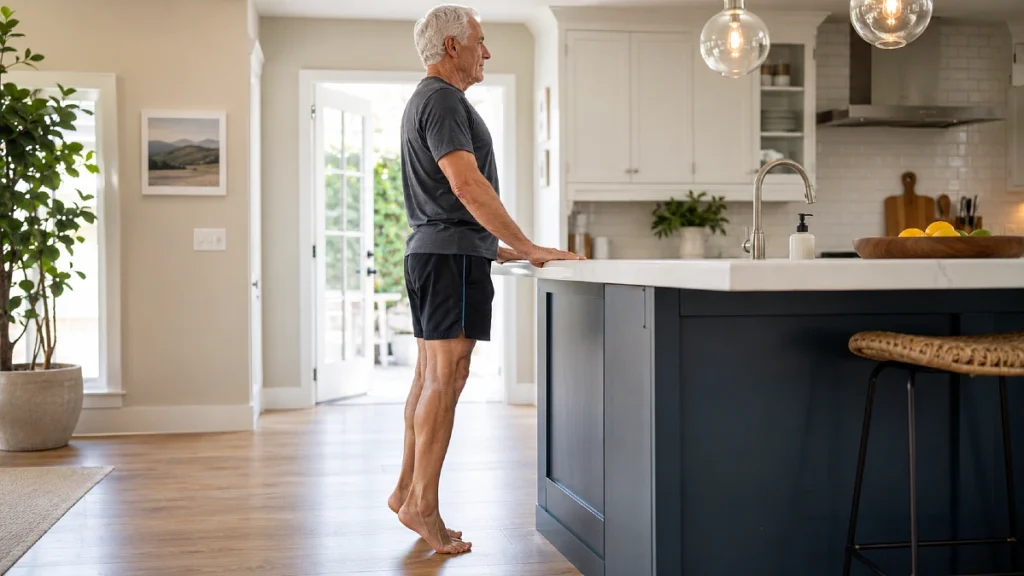
The exercise is a supported standing calf raise.
Stand behind a sturdy chair or at a kitchen counter, rise slowly onto the balls of your feet, pause briefly, then lower your heels with control.
This movement directly contracts the gastrocnemius and soleus muscles in the calf. When these muscles tighten, they compress deep veins and help push blood upward toward the heart.
One way valves inside healthy veins help keep that blood from immediately falling backward. Cleveland Clinic describes this calf muscle pump as a vital part of leg circulation and notes that walking, calf strengthening, and ankle flexing can all support venous blood flow.
That does not make calf raises a cure for blocked arteries. It makes them a focused way to train the muscular pump that supports venous return.
First, Know What “Poor Circulation” May Mean
“Poor circulation” is a symptom description, not a diagnosis.
It may refer to reduced arterial blood entering the leg, weak veins struggling to return blood upward, or a clot blocking a vein. The safest next step changes with the cause.
American Heart Association guidance describes peripheral artery disease pain as aching, burning, cramping, fatigue, or discomfort that appears with walking and eases after rest.
Slow healing foot wounds, skin color changes, calf muscle loss, and one foot feeling cooler than the other are also warning signs.
| Pattern | Common clues | What exercise can do | Best next step |
|---|---|---|---|
| Peripheral artery disease | Calf or thigh pain during walking, relief with rest, cooler foot, slow healing sore | Structured exercise can improve walking ability, but one calf exercise does not remove plaque | Ask for a vascular evaluation and a structured walking plan |
| Chronic venous insufficiency | Ankle swelling, heaviness, aching, visible veins, symptoms worse after long standing | Calf raises and walking may help the calf pump move blood upward | Discuss exercise, leg elevation, and properly fitted compression with a clinician |
| Possible deep vein thrombosis | Sudden swelling in one leg, warmth, redness, tenderness, or pain | Exercise is not a home treatment for a suspected clot | Contact a health professional urgently |
| Sudden artery blockage | Severe sudden pain, pale or cold limb, numbness, weakness, or loss of movement | Do not exercise the limb | Seek emergency care immediately |
The clot and emergency signs in this table come from American Heart Association and Society for Vascular Surgery guidance.
Why Calf Raises Help the “Second Heart”

Your heart pushes blood through arteries toward your feet. The return trip through the veins is harder because blood must travel upward against gravity.
The calf muscles help solve that problem. Each contraction squeezes the veins within and around the calf, creating a pumping action that assists venous return.
Long periods of sitting or standing still reduce this rhythmic assistance. That can encourage blood pooling in people whose vein valves are not working properly.
A supported calf raise makes the contraction deliberate.
The slow rise activates the calf. The brief pause keeps it engaged. The controlled lowering adds strength work without jumping or impact.
Clinical evidence supports the broader principle. In a randomized trial involving people with severe chronic venous insufficiency, a six month structured exercise program improved calf muscle pump function and dynamic calf strength.
The study supports calf conditioning as part of care, although it does not prove that one exact home routine will work for every cause of leg symptoms.
How to Do the Supported Calf Raise Safely
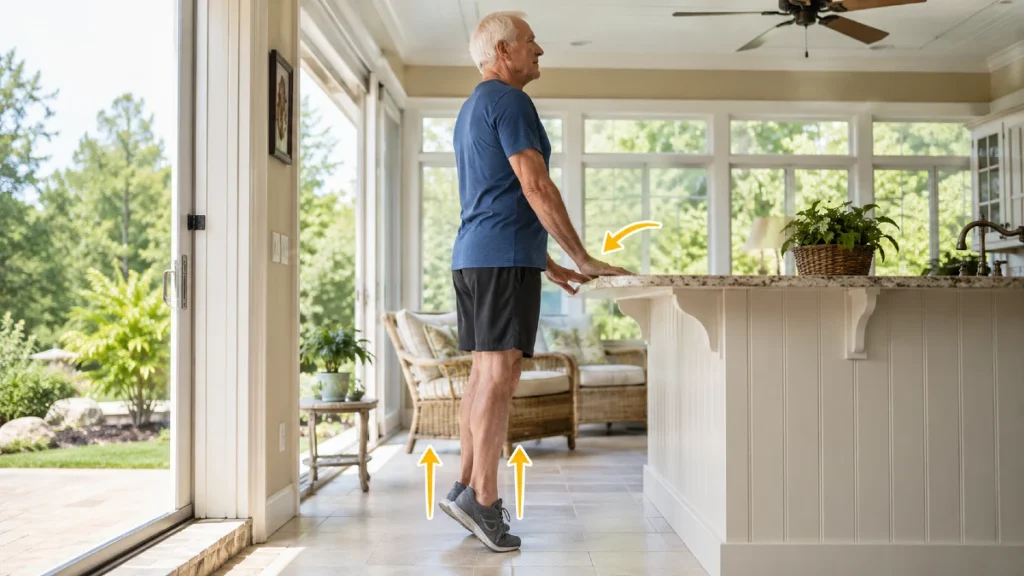
Use a solid counter, heavy chair, or rail that will not slide.
- Stand tall with your feet about hip width apart.
- Place both hands lightly on the support.
- Keep your knees straight but not locked.
- Lift both heels slowly until you are standing on the balls of your feet.
- Hold for one or two comfortable seconds.
- Lower your heels slowly until they touch the floor.
- Stop if you develop sharp pain, chest discomfort, severe shortness of breath, dizziness, or unusual one sided leg symptoms.
A cautious starting target is 8 to 10 repetitions for one set, once a day. If that feels comfortable for several sessions, build toward two sets of 10 to 15 repetitions.
The goal is not to rise as high as possible. The goal is a smooth contraction without bouncing, breath holding, or gripping the floor with your toes.
| Part of the movement | What to focus on | Common mistake | Safer correction |
| Starting position | Tall posture, feet parallel, support within easy reach | Leaning heavily over the counter | Stand closer and use the hands only for balance |
| Rising phase | Slow heel lift with weight through the big toe and second toe | Rolling the ankles outward | Lift only as high as you can keep the ankles aligned |
| Top position | Brief comfortable pause while breathing normally | Holding the breath | Exhale gently and shorten the pause |
| Lowering phase | Controlled return to the floor | Dropping the heels quickly | Count slowly as the heels lower |
| Progression | Add repetitions before adding weight | Using ankle weights too soon | Ask a physical therapist before adding resistance |
Exercise tolerance varies widely after 60. A physical therapist or vascular clinician can modify this movement if you have neuropathy, severe arthritis, balance problems, a recent joint replacement, or a known vascular condition.
Why Walking Is Still Essential

The reference claim that ordinary walking barely activates the calf pump is not supported by vascular guidance.
Each step contracts the calf and helps the veins return blood toward the heart. Walking also creates broader benefits that isolated calf raises cannot match, including aerobic conditioning and repeated blood vessel stimulation.
For chronic symptomatic peripheral artery disease, the 2024 multisociety guideline gives supervised exercise therapy and structured community programs its strongest recommendation for improving walking performance, physical function, and quality of life.
Unstructured advice to simply “walk more” is less reliable because it lacks a planned intensity, duration, progression, and follow up.
NHLBI describes many peripheral artery disease programs as meeting at least three times per week for three to nine months.
Home programs often work toward 30 minutes of walking within a 30 to 50 minute session. They may also include coaching, activity tracking, or regular check ins with a health professional.
The honest message is simple: calf raises fill a strength gap, while structured walking trains the whole circulation system.
A Simple Daily Plan After 60
Use this as a discussion template for your clinician, especially if poor circulation has never been formally diagnosed.
| Time | Action | Purpose |
| Morning | 8 to 10 supported calf raises | Wake up the calf pump and practice controlled strength |
| Every 45 to 60 minutes of sitting | Stand, walk briefly, or perform gentle ankle movements | Break up long periods when the calf pump is quiet |
| Most days | Follow the walking amount approved by your clinician | Improve endurance and support artery and vein health |
| Evening | Check both feet for color changes, blisters, cracks, or sores | Catch skin problems early, especially with diabetes or numbness |
| As advised | Use prescribed compression or leg elevation | Manage venous swelling when medically appropriate |
Compression is not automatically safe for everyone.
Cleveland Clinic cautions that people with peripheral artery disease, heart failure, or active deep vein thrombosis may need to avoid compression or use it only under medical direction.
Try This Today
Five daily checkpoints
The Daily Habit That Actually Works
Combine one controlled movement set with hourly activity, simple symptom tracking, daily foot care, and a focused clinician conversation.
-
Use the counter for steady support and move slowly through one controlled set of calf raises.
-
Take a short walk when practical, or use simple ankle movement when walking is not convenient.
-
Note swelling, walking pain, foot temperature, and any visible skin changes.
-
Wear supportive shoes and inspect both feet every day when reduced sensation may make changes harder to notice.
-
Ask whether your symptoms sound arterial, venous, neurologic, or medication related.
When Calf Raises Are Not the Answer
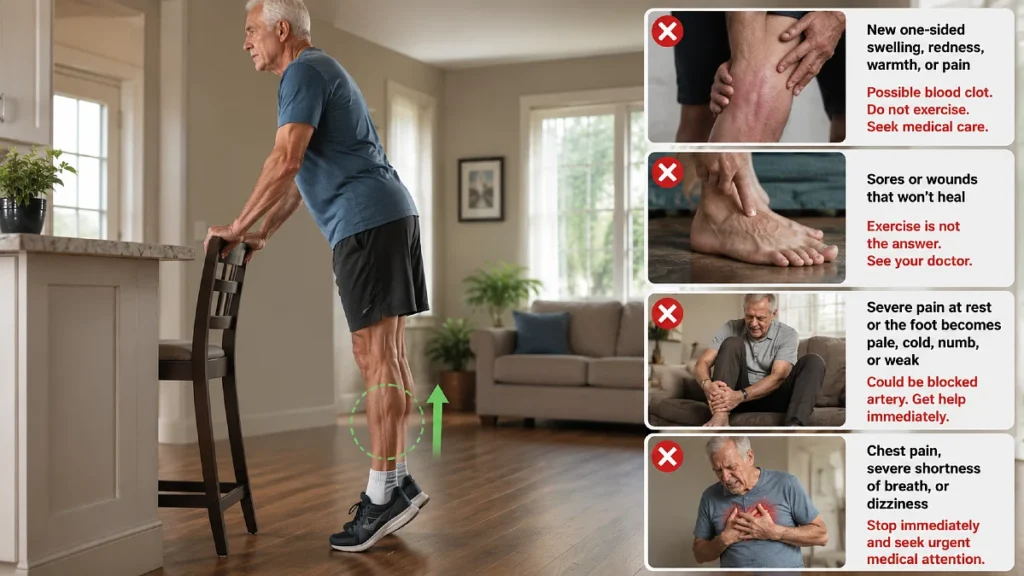
Stop exercising and seek urgent medical advice for new one sided swelling, warmth, redness, or pain.
These can be signs of deep vein thrombosis. A clot can travel to the lungs and cause a life threatening pulmonary embolism.
Seek emergency care for a limb that suddenly becomes severely painful, pale, cold, numb, weak, or difficult to move.
Those are classic signs of acute limb ischemia, which requires rapid treatment to protect the limb.
Arrange prompt medical evaluation for:
- A foot or toe wound that heals slowly or does not heal
- Pain in the foot or forefoot while resting, especially at night
- One foot that is consistently cooler than the other
- Walking pain that repeatedly stops you at a similar distance
- New skin darkening, shiny skin, hair loss, or marked calf shrinkage
These symptoms can appear in advanced artery or vein disease and should not be dismissed as normal aging.
What Results Should You Expect?

A few calf raises may create a temporary feeling of warmth or muscle activity. That sensation does not prove that a blocked artery has opened.
Strength and endurance changes require repeated practice over time. Track practical markers rather than looking for an instant circulation cure.
Notice whether the exercise becomes steadier, whether you can complete more controlled repetitions, whether routine walking feels easier, and whether ankle swelling changes.
Report worsening pain, swelling, skin changes, or wounds instead of simply adding more exercise.
The most useful result may be diagnostic awareness. If symptoms do not fit simple inactivity, a clinician can check your pulses, examine your skin, compare leg temperatures, and decide whether an ankle brachial index is appropriate.
This painless test compares blood pressure at the ankle with blood pressure in the arm and is commonly used to help diagnose peripheral artery disease.
The Bottom Line
The supported standing calf raise is a useful single exercise for directly training the calf muscle pump after 60.
It may support venous return, calf strength, and steadiness when performed safely. It is not a cure for peripheral artery disease, chronic venous insufficiency, blood clots, or unexplained swelling.
Keep walking if your clinician says it is safe. Use calf raises as an addition, and get persistent or one sided symptoms properly diagnosed.
This article is for informational purposes only and is not a substitute for professional medical advice, diagnosis, or treatment. Always consult your doctor or a qualified health care provider before changing your exercise routine, compression use, diet, or medications, especially if you have diabetes, heart disease, kidney disease, neuropathy, a history of blood clots, or known artery disease.